Synergistic effects of size-confined mxene nanosheets in self-powered sustainable smart textiles for environmental remediation
This study presents a sustainable self-powered smart textile based on electrospun cellulose acetate (CA) nanofibers incorporated with ZnO nanoparticles and size-confined MXene (Ti₃C₂) nanosheets. The engineered composite enhances piezoelectric energy harvesting and environmental remediation simultaneously. The optimized textile generates up to 35 V and 3.34 μA from low-frequency mechanical motions while maintaining 92% performance after 20,000 cycles. In addition, the synergistic photo-piezocatalytic effect enables efficient degradation of methyl orange dye, demonstrating the potential of eco-friendly wearable electronics for renewable energy and water purification applications.
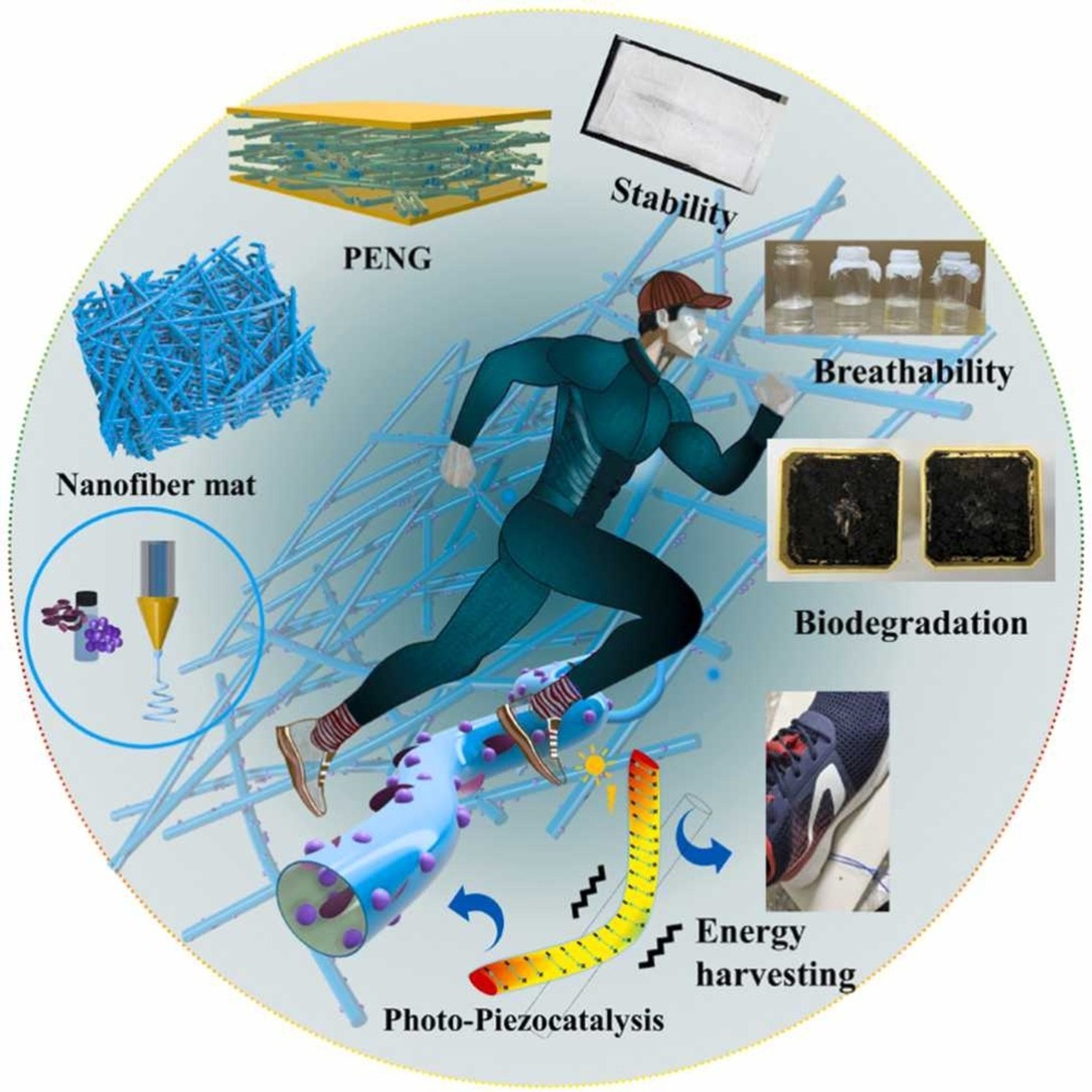
Fig. Graphical Abstract.
Technology Overview
This study presents a sustainable self-powered smart textile based on electrospun cellulose acetate (CA) nanofibers incorporated with ZnO nanoparticles and size-confined MXene (Ti₃C₂) nanosheets. The engineered composite enhances piezoelectric energy harvesting and environmental remediation simultaneously. The optimized textile generates up to 35 V and 3.34 μA from low-frequency mechanical motions while maintaining 92% performance after 20,000 cycles. In addition, the synergistic photo-piezocatalytic effect enables efficient degradation of methyl orange dye, demonstrating the potential of eco-friendly wearable electronics for renewable energy and water purification applications.
Applications & Benefits
The technology can be applied in wearable energy harvesters, self-powered sensors, smart textiles, IoT devices, and wastewater treatment. Key benefits include high energy conversion efficiency (82.4%), long-term durability, biodegradability, self-powered operation, and rapid degradation of organic pollutants through synergistic photo-piezocatalysis.
Abstract:
Green renewable technologies have become a focus of energy research due to the adverse impacts of fossil fuels, greenhouse gases, climate change, global warming, and battery short life. A new generation of biomaterials with spontaneous piezoelectric properties is highly emerging for generating electricity from ubiquitous mechanical energy. Recent years, there has been a concerted effort to engineer robust 1D functional materials for nanogenerators, leveraging cellulose as the foundational material. This research work produced nanofiber composite of zinc oxide (ZnO) nanoparticles and MXene (Ti3C2) nanosheets incorporated into cellulose acetate (CA) polymer through electrospinning process forms the basis for ecofriendly highly durable smart textile fabrication. Formation of MXene nanosheets heterostructures significantly promoted the low conversion efficiency of conventional ZnO to highest output voltage of ⁓35 V, and a short circuit current of ⁓3.34 µA. Synergistic contribution of the piezo-enhanced photocatalytic activity of MXene/ZnO hetero-structured smart nanofibers offers greater environmental remediation of water resources from the contamination of methyl orange (MO) dye with a rate constant (k) of 66.14×10⁻³ min−1. In addition, intelligent dual mechanistic membranes support sustainable operations (20000 cycles) with strong morphological and performance retention (⁓92 %), showing good chemical and mechanical stability even under harsh operating conditions.
Synergistic effects of size-confined mxene nanosheets in self-powered sustainable smart textiles for environmental remediation
Author:Pandiyan Archana, Vengudusamy Renganathan, Veeramuthu Loganathan, Muthuraman Amirthavarshini, Wang Yu-Chen, Lee Hyunjin, Zhou Tao, Kao C.R., Kuo, Chi-Ching
Year:2025
Source publication: Nano Energy, Volume 133, January 2025, 110426
Subfield Highest percentage: 99% Electrical and Electronic Engineering #9 / 1030