Sintered and unsintered pressed fly ash geopolymer: A comprehensive study on structural transformation in nitric and sulfuric acid
Sintered pressed geopolymer (SPG) outperforms room-cured variants in acid resistance. It retains or even gains strength in acidic environments due to continued reactions. SPG’s dense structure prevents cracks from gypsum formation, enhancing durability. These qualities make it ideal for structures exposed to corrosive conditions. The research provides valuable insights for improving the longevity of geopolymer-based materials.
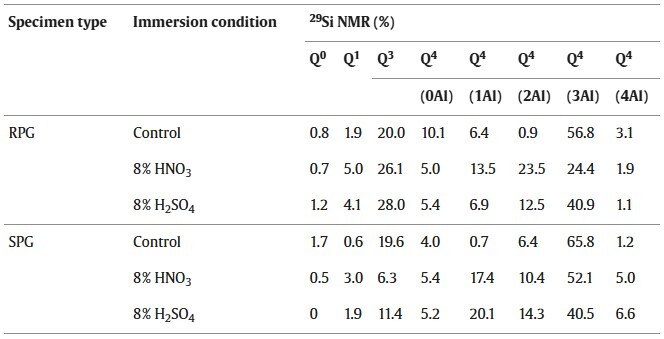
Table 5. 29Si NMR spectra deconvolutions (area%) of RPG and SPG before and after 8 % of HNO3 and H2SO4 immersion for 28 days.
Technology Overview
The acid resistance of SPG is better than that of RPG. RPG showed strength reduction after 28 days, while SPG had strength recovery. Further geopolymerization of SPG during acid immersion led to strength recovery. The well-defined crystalline stabilizes the structure of SPG in acid solutions. NaNO3 and gypsum formed after HNO3 and H2SO4 immersion, respectively.
Applications & Benefits
This study demonstrates that sintered pressed geopolymer (SPG) offers significantly enhanced acid resistance compared to room-cured variants (RPG), especially in environments with nitric and sulfuric acid exposure. SPG shows improved mechanical strength retention, even gaining strength in certain acidic conditions, due to continued geopolymerization and a densely cross-linked structure that limits crack formation. These properties make SPG particularly suitable for infrastructure in corrosive environments, such as industrial plants or sewage systems. The findings offer practical guidance for material selection and design, contributing to longer service life and reduced maintenance of structures. This work also sets the stage for future optimization of mix designs aimed at maximizing acid resistance in geopolymers.
Abstract:
Acidic attacks contribute to the degradation of cementitious materials, diminishing the structural service life and increasing the requirement for maintenance of the structure. To address the limited understanding of the impact of the sintering process on the acid resistance of pressed geopolymer, an investigation and comparison of the acid resistance of room-cured (RPG) and sintered (SPG) pressed geopolymer was performed. Specimens were immersed in 3 % and 8 % nitric (HNO3) and sulfuric (H2SO4) acids for 7 and 28 days. Despite the higher sorptivity, SPG demonstrated better mechanical strength retention than that of RPG. Specifically, the compressive strength of SPG after 3 % of HNO3 immersion for 28 days increased (+14.2 %), surpassing the control specimen, while RPG experienced a 14.5 % strength drop. The strength increment in SPG was due to the further geopolymerization during acid immersion. In RPG, a new crystalline phase of NaNO3 was observed after immersion in 8 % HNO3 for 28 days. In contrast, SPG showed no evidence of NaNO3 formation, indicating lower reactivity with HNO3 compared to RPG. Additionally, both RPG and SPG exhibited gypsum formation after immersion in H2SO4. The presence of gypsum induced crack formation in RPG, whereas SPG, with its intensive cross-linked structure, effectively compensated for gypsum expansion, preventing crack formation. This finding is crucial for practical applications where exposure to aggressive acids is a concern, as it provides a method to enhance the acid resistance of geopolymer structures.

Sintered and unsintered pressed fly ash geopolymer: A comprehensive study on structural transformation in nitric and sulfuric acid
Author:Shee-Ween Ong, Cheng-Yong Heah, Yun-Ming Liew, Li-Ngee Ho, Wei-Hao Lee, Mohd Mustafa Al Bakri Abdullah, Wei-Ken Part, Yong-Jie Hang, Pin-Hsun Liao
Year:2024
Source publication:Journal of Building Engineering, Volume 93, 15 September 2024
Subfield Highest percentage:99% Architecture #2 / 203
https://www.sciencedirect.com/science/article/pii/S2352710224013913