Rationally Improved Surface Charge Density of Triboelectric Nanogenerator with TiO2-MXene/Polystyrene Nanofiber Charge Trapping Layer for Biomechanical Sensing and Wound Healing Application
This study adopted a batch-normalized long short-term memory (BN-LSTM)-based data-driven method to predict the power consumption of IR manipulators. The model was verified using the UR3e and UR10e public datasets. Finally, we adopted the BN-LSTM model to build a reliable EC model. A comprehensive comparison is presented. Then, an unseen dataset testing experiment was conducted to test the ability of the adopted model to generalize the data collected during the polishing motion task.
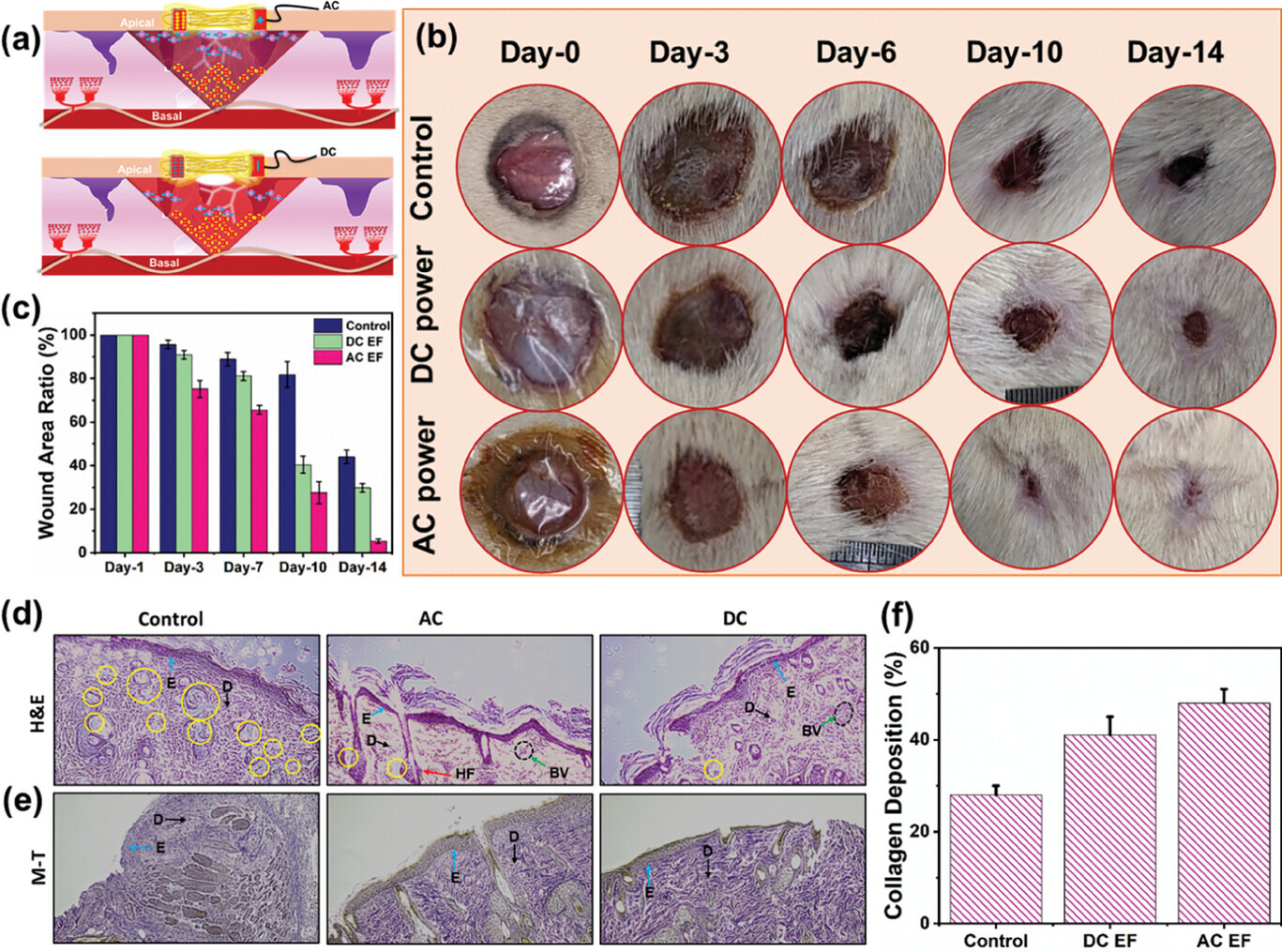
Figure 6. a) Schematic demonstration of AC and DC ES process on wounded area. b) Photograph of wounded skin at various time intervals. c) Wound area recovery after 3, 7, 10, 14 d of treatment. d) H&E and e) M–T histogram examination of newly formed skin tissue. f) Collagen density measurement of M–T image.
Technology Overview
In summary, we improved the S-TENG device surface charge density and output performance through a new regulated charge-trapping mechanism of interfacial polarization. Through the intercepting of PTMx NFM, we were able to increase the charge-storing capacity as well as the resistance to charge recombination.
Applications & Benefits
Prior to this wound healing experiment, the efficiency of S-TENG was verified by in vitro and in vivo tests. The device tested in both AC and DC modes of operation showed better results. Thus, the multiple features of S-TENG with wearable advantage are expected to have a significant impact in sensors as well as therapeutic medicinal areas of research.
Abstract:
Triboelectric nanogenerators (TENGs) have become reliable green energy harvesters by converting biomechanical motions into electricity. However, the inevitable charge leakage and poor electric field (EF) of conventional TENG result in inferior tribo-charge density on the active layer. In this paper, TiO2-MXene incorporated polystyrene (PS) nanofiber membrane (PTMx NFM) charge trapping interlayer is introduced into single electrode mode TENG (S-TENG) to prevent electron loss at the electrode interface. Surprisingly, this charge-trapping mechanism augments the surface charge density and electric output performance of TENGs. Polyvinylidene difluoride (PVDF) mixed polyurethane (PU) NFM is used as tribo-active layer, which improves the crystallinity and mechanical property of PVDF to prevent delamination during long cycle tests. Herein, the effect of this double-layer capacitive model is explained experimentally and theoretically. With optimization of the PTMx interlayer thickness, S-TENG exhibits a maximum open-circuit voltage of (280 V), short-circuit current of (20 µA) transfer charge of (120 nC), and power density of (25.2 µW cm−2). Then, this energy is utilized to charge electrical appliances. In addition, the influence of AC/DC EF simulation in wound healing management (vitro L929 cell migration, vivo tissue regeneration) is also investigated by changing the polarity of trans-epithelial potential (TEP) distribution in the wounded area.

Rationally Improved Surface Charge Density of Triboelectric Nanogenerator with TiO2-MXene/Polystyrene Nanofiber Charge Trapping Layer for Biomechanical Sensing and Wound Healing Application
Author:Manikandan Venkatesan, Jayashree Chandrasekar, Yung-Chi Hsu, Ting-Wang Sun, Po-Yu Li, Xuan-Ting King, Ming-An Chung, Ren-Jei Chung, Wen-Ya Lee, Ye Zhou, Ja-Hon Lin, Chi-Ching Kuo
Year:2024
Source publication:Advanced Science, Volume11, Issue34, September 11, 2024
Subfield Highest percentage:99% Biochemistry, Genetics and Molecular Biology (miscellaneous) #1 / 125
https://advanced.onlinelibrary.wiley.com/doi/full/10.1002/advs.202404019