BN-LSTM-based energy consumption modeling approach for an industrial robot manipulator
This study adopted a batch-normalized long short-term memory (BN-LSTM)-based data-driven method to predict the power consumption of IR manipulators. The model was verified using the UR3e and UR10e public datasets. Finally, we adopted the BN-LSTM model to build a reliable EC model. A comprehensive comparison is presented. Then, an unseen dataset testing experiment was conducted to test the ability of the adopted model to generalize the data collected during the polishing motion task.
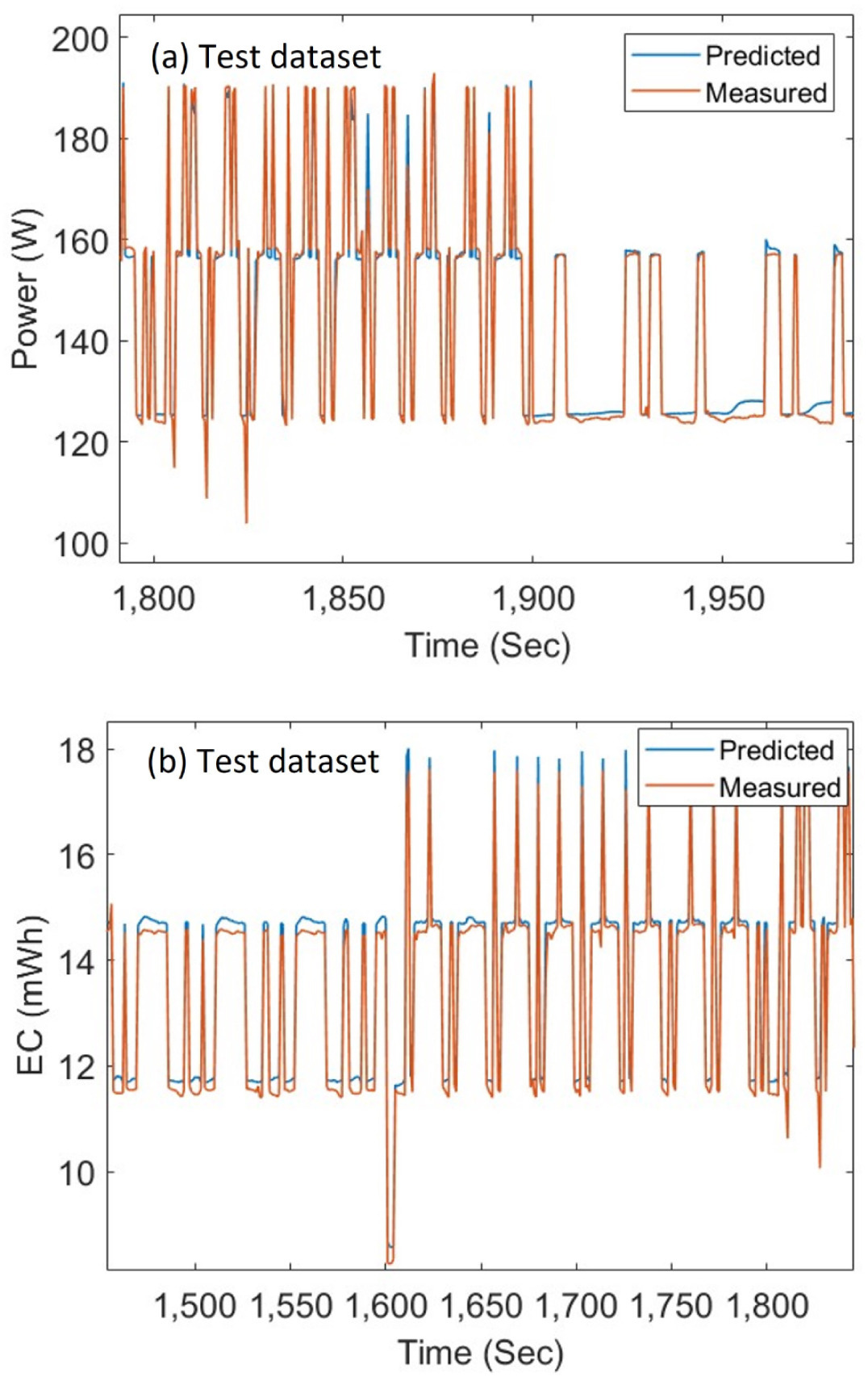
Fig. 15. Unseen test data from polishing instruction (MOVL, MOVJ, and MOVC) (a) Power prediction in Watt and (b) Energy prediction in mWh.
Technology Overview
This manuscript proposes BN-LSTM-based Energy Consumption Modeling Approach for an Industrial Robot Manipulator. The major contribution of the manuscript is to propose a competitive AI modeling for robotic energy consumption. The proposed model achieved outstanding performance of Root Mean Squared (RMS) error improvement 56.74% and 23.22% on the UR3e and UR10e datasets (Yao et al., 2022); (Heredia et al., 2021) respectively. By adopting an input-to-hidden transition mechanism, our proposed energy prediction model outperformed other related previous models, namely Linear Regression (LR), Regression Trees (RTs), Ensembles Tress (ETs), Support Vector Machine (SVR), feed-forward neural network, and CNN-GRU model. The result comparison provided in the Result Section. This manuscript also introduces our dataset, namely the Yaskawa GP7 dataset. It contains 64,600 samples with 18 features for polishing motion. Our work datasets provide a less complex feature data format than UR3e and UR10e datasets. With that, the researchers can quickly adopt and implement their energy-robot analysis for future works.
Applications & Benefits
This study provided an in-depth look at the research and real-world methods used to predict the power profile and EC of IRs before they are used in a production system. We adopted a BN-LSTM-based data-driven modeling method to predict the power and EC of IRs. In the future, we will use a different payload scenario. The main concern is to increase productivity and achieve cost-effective robotic operation, as the data-driven deep learning model and transfer learning method have opened the door to a wide range of applications to construct automatic commercial products that can optimize the EC of IRs. We will also investigate the direct carbon footprint of any IR operation to propose an optimal solution for reducing carbon emissions.
Abstract:
Industrial robots (IRs) are widely used to increase productivity and efficiency in manufacturing industries. Therefore, it is critical to reduce the energy consumption of IRs to maximize their use in polishing, assembly, welding, and handling tasks. This study adopted a data-driven modeling approach using a batch-normalized long short-term memory (BN-LSTM) network to construct a robust energy-consumption prediction model for IRs. The adopted method applies batch normalization (BN) to the input-to-hidden transition to allow faster convergence of the model. We compared the prediction accuracy with that of the 1D-ResNet14 model in a UR (UR3e and UR10e) public database. The adopted model achieved a root mean square (RMS) error of 2.82 W compared with the error of 6.52 W achieved by 1D-ResNet14 model prediction, indicating a performance improvement of 56.74%. We also compared the prediction accuracy over the UR3e dataset using machine learning and deep learning models, such as regression trees, linear regression, ensemble trees, support vector regression, multilayer perceptron, and convolutional neural network-gated recurrent unit. Furthermore, the layers of the well-trained UR3e power model were transferred to the UR10e cobot to construct a rapid power model with 80% reduced UR10e datasets. This transfer learning approach showed an RMS error of 3.67 W, outperforming the 1D-ResNet14 model (RMS error: 4.78 W). Finally, the BN-LSTM model was validated using unseen test datasets from the Yaskawa polishing motion task, with an average prediction accuracy of 99%.
BN-LSTM-based energy consumption modeling approach for an industrial robot manipulator
Author:Hsien-I Lin, Raja Mandal, Fauzy Satrio Wibowo
Year:2024
Source publication:Robotics and Computer-Integrated Manufacturing Volume 85, February 2024
Subfield Highest percentage:99% Mechanical Engineering # 3 / 631
https://www.sciencedirect.com/science/article/pii/S0736584523001047