Effect of void space arrangement on wind power potential and pressure coefficient distributions for high-rise void buildings
With the purpose of strengthening the local wind resource availability for energy harvesting, this study conducts the comprehensive evaluation of the wind power potential, turbulence intensity and pressure coefficient around a typical 2 × 2 compact high-rise building array at varying void sizes, void heights and wind directions.
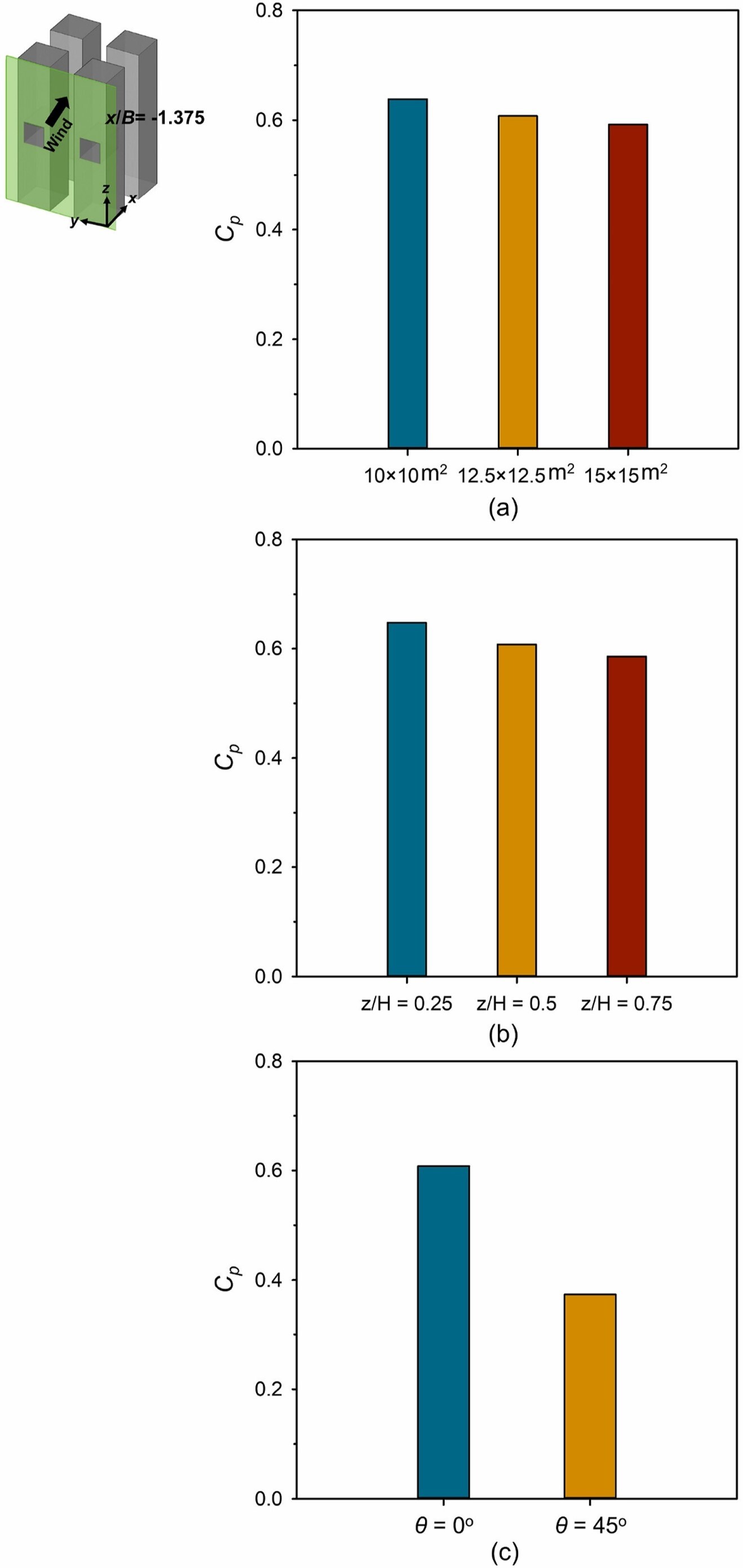
Fig. 13. Comparison of histograms of average pressure coefficients over facades of upstream buildings for varied (a) void sizes, (b) void heights and (c) wind directions.
Technology Overview
Analysis of wind energy potential and wind load for high-rise void buildings is conducted. Effects of opening design and wind direction on power density and pressure are studied. Void space can improve urban ventilation and wind energy with normalized power density up to 1.1. Upstream gap passage and void channels are suitable sites to install turbines.
Applications & Benefits
The CFD predictions are reasonably consistent with the measured dimensionless streamwise mean velocity (U/Uref) and turbulence intensity (Ti) profiles from the wind tunnel experiments over the gap passage and void channel of the building array. An increase in void size can augment the wind velocities for enhancement of power densities as well as lessen the unacceptable turbulence level on the installable sites over the void channel and gap passage. The favorable wind power densities in conjunction with satisfactory turbulence intensities develop over the opening holes and gap passages with increasing void heights. The wind direction of 45° can produce less high power density and more unacceptable turbulence level areas as well as an appreciable decrease in pressure coefficient on the facades due to the oblique impingement of flows on upstream void buildings, as compared to the normal wind of 0°. With the void sizes of 10 × 10–15 × 15 m2, void heights of z/H = 0.25–0.75 and wind directions of 0°, 45°, the upstream gap passage and void channels are pinpointed as the most promising mounting sites of turbines due to their excellent PD/PDref up to 1.1 with suitable Iref range and reduced wind loads on structures. The obtained results are useful to develop the design guidelines of high-rise void buildings for urban planning and wind energy exploitation.
Abstract:
High-rise void building complexes can augment the permeation of airflows over buildings, and thereby strengthen urban wind energy harvesting for realization of the sustainable development goals (SDGs). This paper considers the wind over a typical 2 × 2 compact high-rise building array with the openings to analyze the wind power potential at varying void sizes, locations of voids, and direction of incoming wind. The predicted mean wind speeds and turbulence intensities are compared against the measured data with 4 generic high-rise building models having voids in an atmospheric boundary layer wind tunnel for validation of the computational model. Based on the comparative results from four common Reynolds-averaged Navier-Stokes (RANS) turbulence models including the standard, realizable, renormalization group (RNG) k-ε, and shear-stress transport (SST) k-ω models as well as the Reynolds stress model (RSM), the RSM approach can provide the most accurate predictions of streamwise mean velocity and turbulence intensity. The present study then conducts CFD simulations to explore the effects of opening configuration and wind direction on the wind field around high-rise void buildings. Considering the variations of void sizes of 10 × 10 m2, 12.5 × 12.5 m2, 15 × 15 m2, void heights of z/H = 0.25, 0.5, 0.75 and wind directions of 0°, 45°, respectively, the simulated results indicate elevated wind power densities with acceptable turbulence intensities over the upstream gap passage and void channels to achieve prospective urban wind power harvest and mitigate wind load on structures of high-rise void buildings.

Effect of void space arrangement on wind power potential and pressure coefficient distributions for high-rise void buildings
Author:Lee Yee-Ting, Lo Yuan-Lung, Juan Yu-Hsuan, Li Zhengtong, Wen Chih-Yung, Yang An-Shik
Year:2023
Source publication:Journal of Building Engineering Volume 75, 15 September 2023
Subfield Highest percentage:99% Architecture # 1 / 189
https://www.sciencedirect.com/science/article/pii/S2352710223012408