Motivational beliefs moderate the relation between academic delay and academic achievement in online learning environments
The goal of the current study is to address these gaps by leveraging learning analytics and through a longitudinal data analysis in hopes of clarifying the nature of academic delay and revealing whether and under what condition academic delay is harmful for academic achievement in online learning environments.
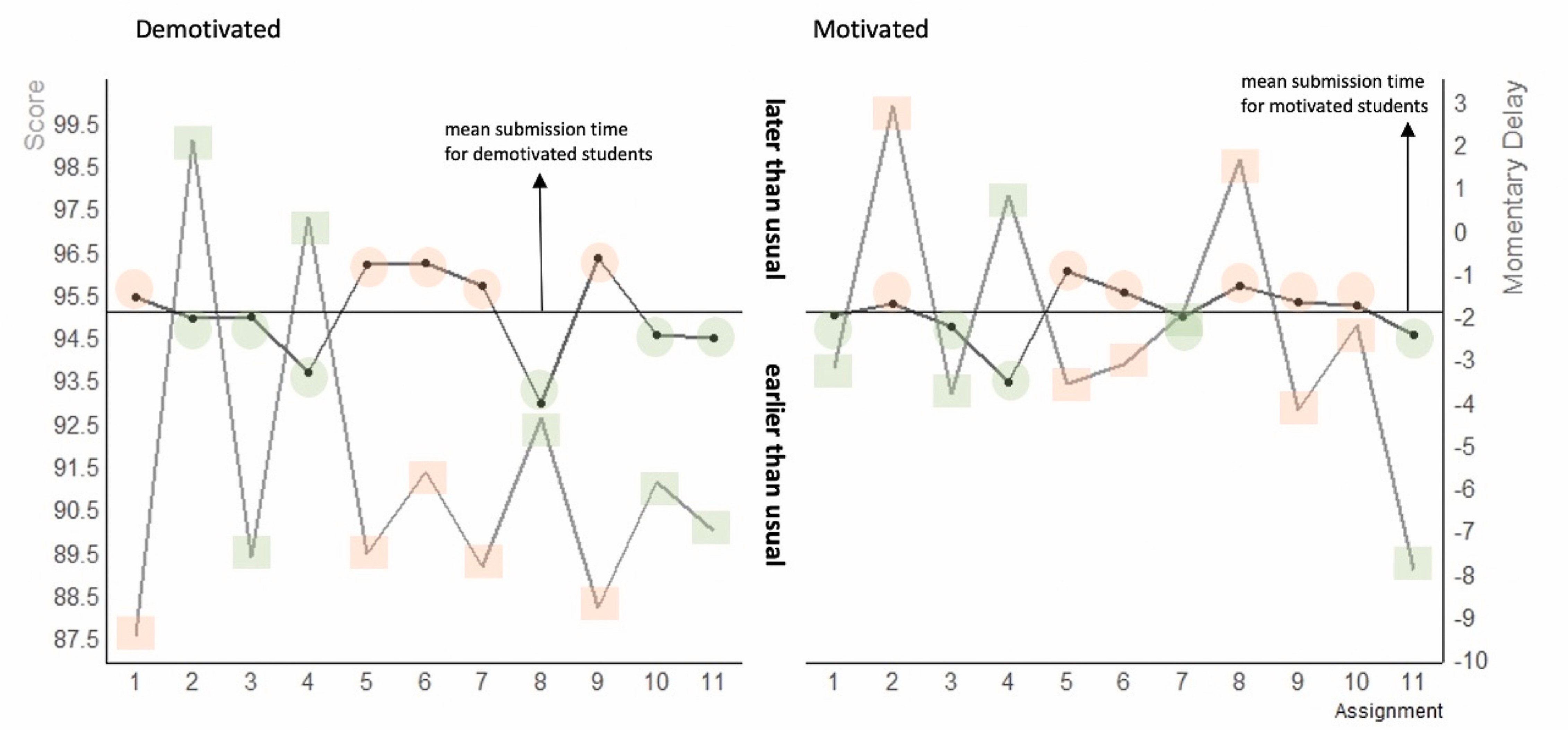
Fig. 4. Longitudinal relation between momentary delay and academic achievement by levels of academic self-efficacy.
Note. Orange circle = submission time later than usual; orange square = score for assignment submitted later than usual; green circle = submission time earlier than usual; green square = score for assignment submitted earlier than usual.
Technology Overview
Academic delay in online learning environments was examined. Academic delay contained habitual and momentary components. Habitual delay was more harmful for academic achievement. Academic delay was more harmful for demotivated students. Academic delay was less consequential for motivated students.
Applications & Benefits
In conclusion, the current study examined the relations between academic delay, motivational beliefs, and academic achievement in an online science course among college students. Through a longitudinal data analysis, the current study reveals that academic delay contains habitual and momentary components. Although both components are negatively related to academic achievement, habitual delay is more harmful, and the maladaptive nature of academic delay is dependent on students' motivational beliefs. Academic delay is particularly harmful for demotivated students and less consequential for motivated counterparts. A single episode of academic delay may not be a reliable and valid predictor of academic achievement. Understanding who is postponing and determining his/her motivation towards coursework are more important than simply focusing on students' dilatory behaviors in online learning environments.
Abstract:
Academic delay can be understood as individuals' behavioral postponement of their work in academic settings. The purpose of this study was to examine the relations between academic delay, motivational beliefs, and academic achievement in an online science course. The sample included one hundred and sixty-eight undergraduate students. Leveraging learning analytics and using multilevel modeling, this study found that academic delay was composed of habitual and momentary components. Controlling for motivational beliefs, habitual delay was significantly more negative than momentary delay in relation to academic achievement. The relation between academic delay and academic achievement was moderated by motivational beliefs. The negative effect of momentary delay on academic achievement was dependent on academic self-efficacy, while the negative effect of habitual delay on academic achievement was dependent on emotional cost. These findings further confirm that academic delay in online learning environments is not necessarily harmful for college students. Simply focusing on academic delay without considering who is engaging in such behavior could be misleading for future intervention.

Motivational beliefs moderate the relation between academic delay and academic achievement in online learning environments
Author:Cheng Shonn, Xie Kui, Collier Jessica
Year:2023
Source publication:Computers & Education Volume 195, April 2023
Subfield Highest percentage:99% Education #1 / 1543
https://www.sciencedirect.com/science/article/pii/S0360131523000015