Conscientiousness, prior experience, achievement emotions and academic procrastination in online learning environments
Conscientiousness has a direct association with academic procrastination in online learning environments. Prior online learning experience has no direct associations with academic procrastination in online learning environments. Conscientiousness indirectly relates to academic procrastination through achievement emotions in online learning environments. Prior online learning experience indirectly relates to academic procrastination through achievement emotions in online learning environments. Instructors are suggested to pay attention to students with low conscientiousness and few prior online learning experiences since they are more likely to procrastinate in online learning environments. Students' tendency to procrastinate in online learning environments is strongly associated with their emotional experience.
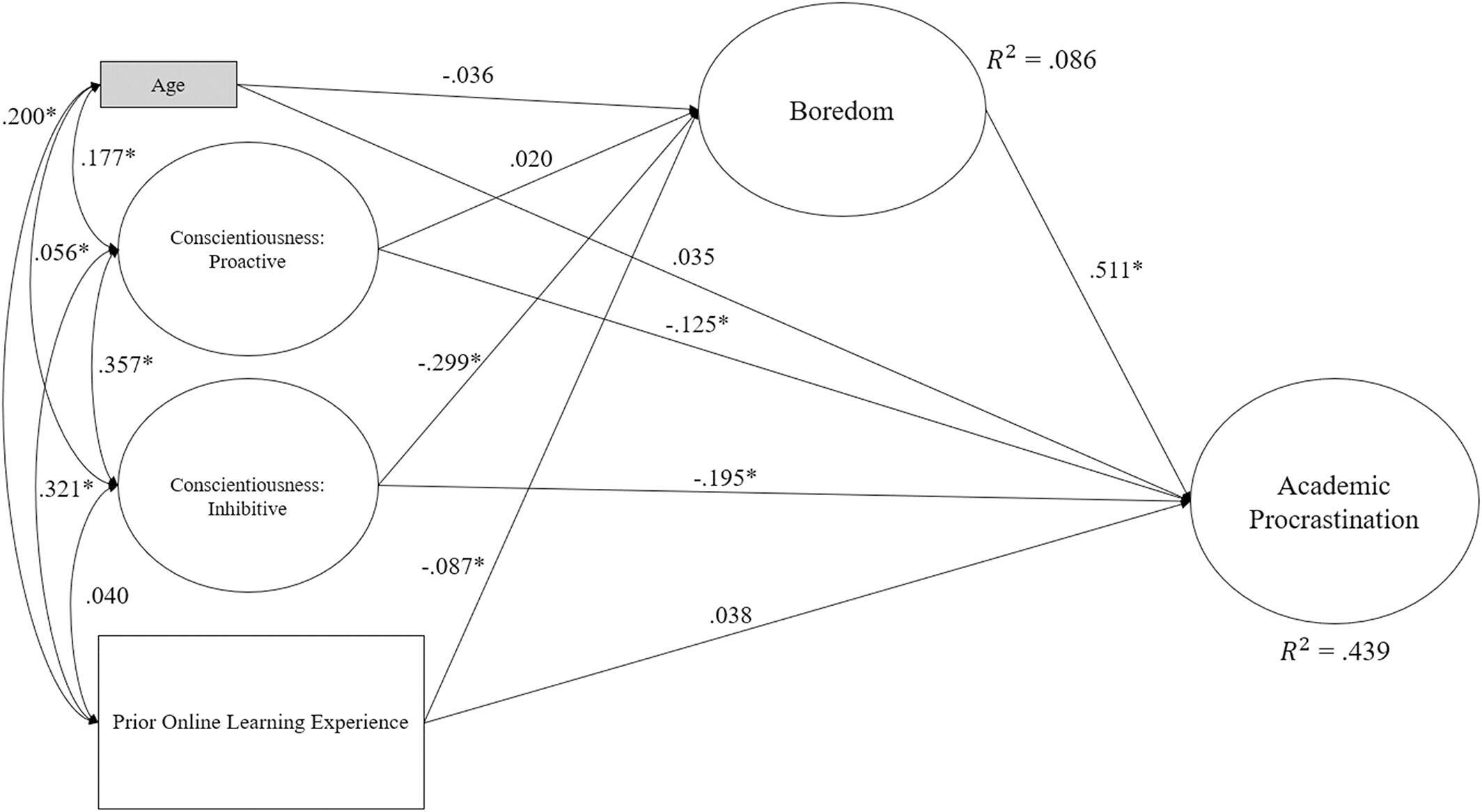
Structural model: Boredom. * refers to p < 0.05.
Technology Overview
In conclusion, the goal of the current study was to examine the structural relations between conscientiousness, prior online learning experience, achievement emotions and academic procrastination in online learning environments. Students with lower conscientiousness and fewer prior online learning experience are more likely to procrastinate in online learning environments owing to their lower likelihood to experience enjoyment and higher likelihood of experience negative emotions in coursework. More research is needed to verify the findings reported here and examine academic procrastination in self-paced online learning environments.
Applications & Benefits
In terms of practical implications, the current study suggests that conscientiousness and online learning experience are reasonable targets for intervention in experimental research on reducing procrastination in online learning environments. Roberts et al. (2017) offered theoretical perspectives on how to change conscientiousness. Scholars who aim to target conscientiousness in future experimental studies are encouraged to consult their work. However, there is no established approach to enhance online learning experience in the existing literature. We encourage scholars to explore viable ways to manipulate students' perceptions of online learning experience within a reasonable period of time. Instructors are suggested to pay attention to students with low conscientiousness and novice online learners. These students are more likely to engage in unnecessary delay in online classes.
Abstract:
Academic procrastination refers to individuals' unnecessary postponement of their coursework and is harmful for academic performance. When situated in self-placed and remote learning environments, students' tendency to procrastinate increases. Therefore, understanding why students procrastinate and identifying who is more likely to delay unnecessarily in online learning environments is an important area to study. The goal of this study was to respond to this call by examining the structural relations between conscientiousness, prior online learning experience, achievement emotions and academic procrastination in online learning environments using structural equation modelling. In particular, two main facets of conscientiousness—proactive and inhibitive—were examined in order to understand which facet was more responsible for procrastination, how each facet was related to procrastination and to determine which facet of conscientiousness should be the primary target for intervention in future experimental research. A total of 746 students from 49 secondary and postsecondary schools participated in the current study. The results showed that the proactive aspect of conscientiousness was negatively related to academic procrastination through the pathway of enjoyment. The inhibitive aspect of conscientiousness was negatively related to academic procrastination through the pathways of negative emotions. Although prior online learning experience did not have a significant and direct association with academic procrastination, it was indirectly related to students' tendency to put off coursework through the pathways of enjoyment and negative emotions. Of all the paths, negative emotions had the strongest associations with academic procrastination in online learning environments. The findings of indirect effects suggest that students with low conscientiousness, the inhibitive aspect in particular, and few prior online learning experiences are more likely to procrastinate in online classes possibly owing to the suboptimal emotional experiences aroused during their learning processes.

Conscientiousness, prior experience, achievement emotions and academic procrastination in online learning environments
Author:Cheng Sheng-Lun, Chang Jen-Chia, Quilantan-Garza Karina, Gutierrez Mary L.
Year:2023
Source publication:British Journal of Educational Technology, Volume54, Issue4
July 2023
Subfield Highest percentage:99% Education #15 / 1543
https://bera-journals.onlinelibrary.wiley.com/doi/10.1111/bjet.13302