Stretchable photosynaptic transistor with an ultralow energy consumption conferred using conjugated block copolymers/perovskite quantum dots nanocomposites
This study improves the self-aggregation of PeQDs through solvent selectivity of BCPs and applies it to an FSPD. The findings of this study offer valuable insights into the mechanisms of charge trapping and variations in the EPSC in BCP and PeQDs. These insights hold great potential for advancing the field of low-energy-consumption and stretchable artificial synapses, enabling innovative technologies that resemble human-like memory, artificial muscle, wearable electronics, and pattern recognition.
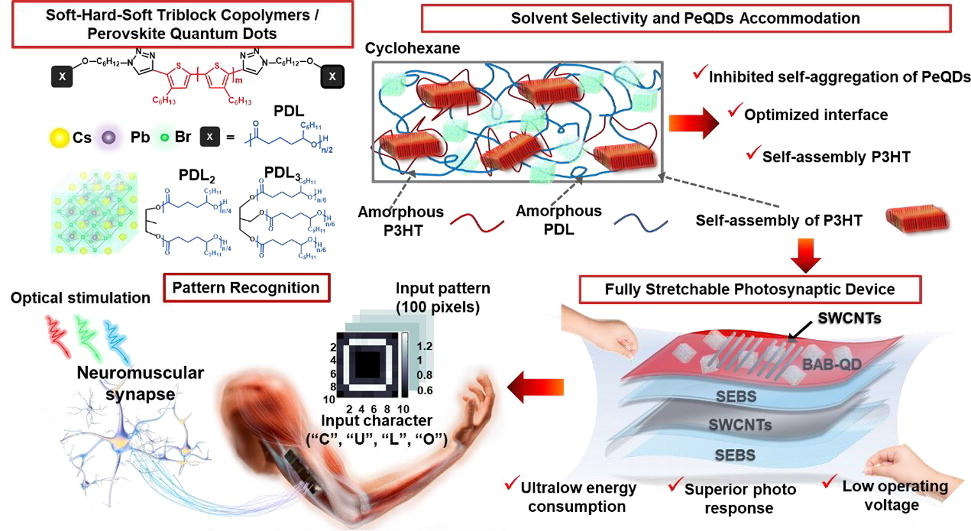
A fully stretchable photosynaptic device with low energy consumption is achieved by the intrinsic stretchability of conjugated block copolymers and the accommodation of perovskite quantum dots. The strategy emulates photosynapse functionalities and provides an artificial muscle's neural network with high recognition accuracy, thereby representing potentially major advances in soft optoelectronics.
Technology Overview
An improvement of PeQDs aggregation and a fully stretchable photosynaptic device have been demonstrated by using PDL-based conjugated BCPs with solvent selectivity and intrinsic stretchability. The BCPs with different branches and architectures were analyzed using atomic force microscopy (AFM), high-resolution transmission electron microscopy (HR-TEM), and time-of-flight secondary ion mass spectroscopy (ToF-SIMS) to investigate their impact on the dispersion of PeQDs. Our results showed that the appropriate solvent selectivity of BCPs could restrict the interrupted assembly of P3HT and the accommodability of PeQDs, effectively improving the aggregation of PeQDs. From the transient photocurrent detection, BCP/PeQDs nanocomposite showed the fastest response time (1 ms), the lowest operating drain voltage (VDS = –0.1 V), and the highest current contrast (4.9 × 10⁵).
Applications & Benefits
In summary, an improved aggregation of PeQDs and the development of a fully stretchable photosynaptic device were demonstrated using a conjugated BCP with solvent selectivity and intrinsic stretchability. Various characterization techniques, including AFM, HR-TEM, and ToF-SIMS, were employed to analyze the different branches of the BCPs and their impact on PeQDs dispersion. The results showed that the appropriate solvent selectivity of the BCPs effectively controlled the assembly of P3HT and the accommodation of PeQDs, leading to improved PeQDs aggregation, larger grain size, and optimized interfaces between P3HT and PeQDs.
Abstract:
Emulation of photonic synapses offers a promising avenue for developing low-energy consumption of soft electronics, neurologically inspired robotics, and neuromorphic network computation. In this paper, a fully stretchable photosynaptic device with ultralow energy consumption using intrinsically stretchable poly(δ-decanolactone) (PDL)-based conjugated block copolymers (BCPs) with perovskite quantum dots (PeQDs) is first reported. The findings reveal that selectively choosing solvents for the PDL-based BCPs effectively regulates the assembly of P3HT and the accommodation of PeQDs, leading to improved self-aggregation of PeQDs, increased grain size, and optimized interfaces between P3HT and PeQDs The BCPs/PeQDs composite effectively emulates significant features of photonic synapses, such as paired-pulse facilitation (PPF), spike-dependent and short/long-term neuroplasticity, demonstrating excellent performance, including the fastest response time (1 ms), the highest current contrast (4.9 × 10⁵), PPF (1.93) and ultra-low energy consumption (0.3 aJ) at an operating voltage of –0.1 mV. Furthermore, the BCP/PeQDs exhibit remarkable neuromuscular synapse characteristics, including high strain and bending tolerance and spike-dependent plasticity, enabling the devices to achieve high classification accuracy in artificial neural network simulations during tensile strain. The accommodation solvent selectivity of BCP/PeQDs suggests a promising strategy for advancing neurologically soft electronics, human-like pattern recognition, and neuromorphic computation.
Stretchable photosynaptic transistor with an ultralow energy consumption conferred using conjugated block copolymers/perovskite quantum dots nanocomposites
Author:Chen Wei-Cheng, Lin Yan-Cheng, Hung Chih-Chien, Hsu Li-Che, Wu Ya-Shuan, Liu Cheng-Liang, Kuo Chi-Ching, Chen Wen-Chang
Year:2023
Source publication:Materials Today Volume 70, November 2023
Subfield Highest percentage:99% Mechanical Engineering #4 / 672
https://www.sciencedirect.com/science/article/pii/S1369702123003395