A systematic review of the incorrect use of an empirical equation for the estimation of the rainfall erosivity around the globe
The main aim of this study was to prepare a systematic review together with bibliometric and statistical analysis of papers that incorrectly used or cited the MFI-based equation proposed by Arnoldus (1977). In addition, the second major objective was to quantify the potential impact of this error on soil erosion studies.
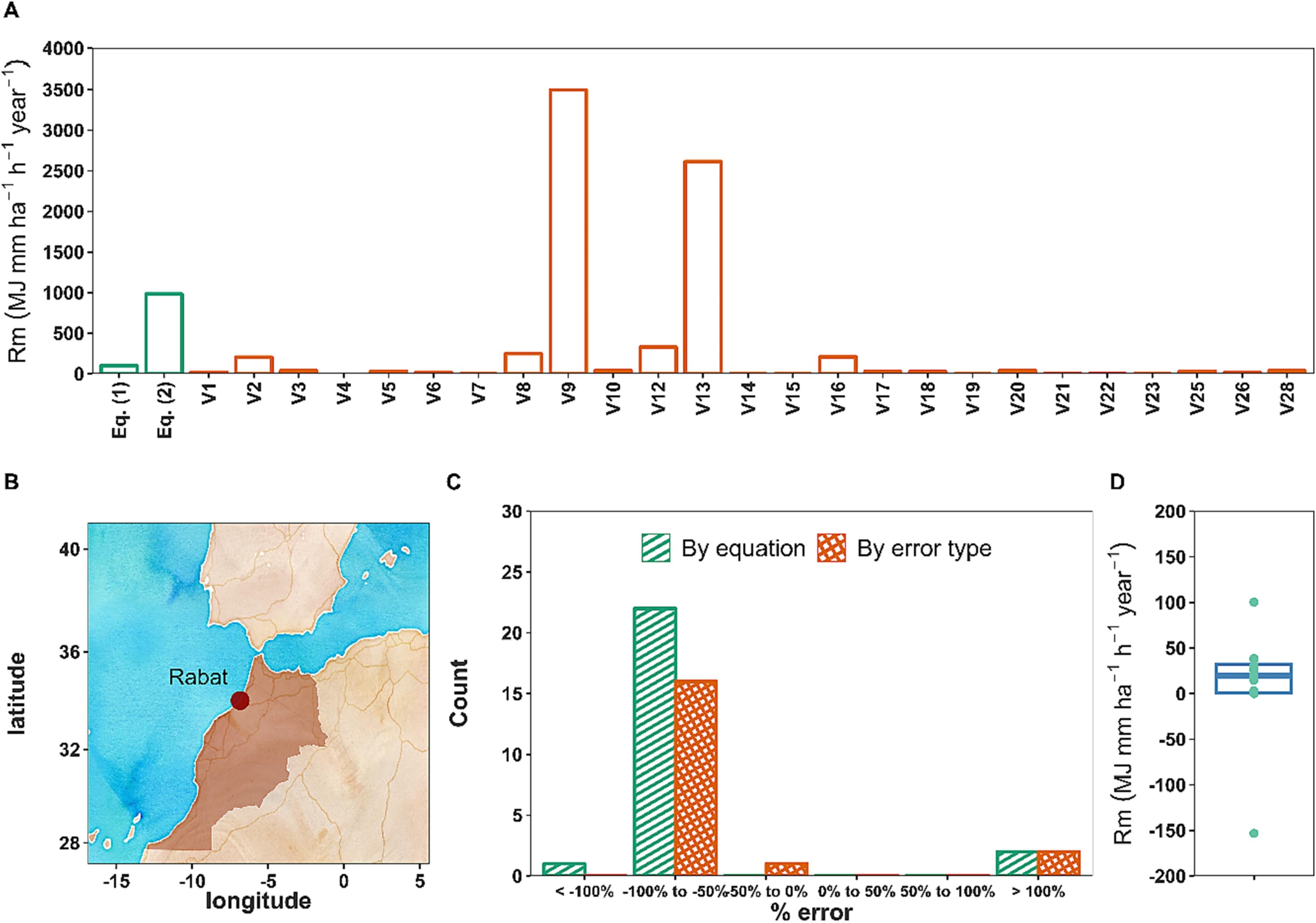
Fig. 8. The comparison of incorrect versions of R equations in Table 1 for the city of Rabat in Morocco: (A) the rainfall erosivity calculated by the 28 incorrect equations in Table 1; (B) the location of Rabat; (C) the distribution of error margins by equation or by error code; and (D) the box-whisker plot of the rainfall erosivity values.
Technology Overview
The specific aims of this study were: (i) to conduct bibliometric analysis and to examine citation and bibliographic patterns of studies that incorrectly used the equation; (ii) to identify the first study that incorrectly cited this equation and to investigate the temporal and spatial spread of the incorrect use of the equation and its derivatives; and (iii) to quantify the potential bias in rainfall erosivity estimation in case of incorrect use of the equation proposed by Arnoldus (1977).
Applications & Benefits
The study aimed to bring attention to the error and prevent the spread of incorrect R equations. It's important to remember that proper parameterization of individual factors is crucial in USLE-type models. Any deviation from the suggested methods should be done with caution. Hence, it is imperative that the soil erosion modelling community improve its practices in order to produce more reliable results. This is particularly important given the other issues that exist within this field, such as the stretching of data and models beyond their limitations (Parsons, 2019), the misuse of equations (Auerswald et al., 2014), and the lack of proper model calibration and evaluation (Batista et al., 2019; Bezak et al., 2021). The deliberate and focused effort will benefit the entire scientific community. Finally, as a suggestion, the soil erosion modelling community should learn from the misuse of the R equation identified in this study and devise better practices to avoid similar errors in the future.
Abstract:
Soil erosion is part of the erosion-sedimentation cycle and a type of land degradation that can be caused by poor land management. This is expected to be exacerbated by climate change. The rainfall erosivity factor (R) of the Universal Soil Loss Equation (USLE) family of soil erosion models is one of the most important parameters being studied because it is heavily influenced by climate change. The determination of the R factor necessitates high-frequency precipitation data, which are unavailable for a significant portion of the globe. For decades, researchers in data-sparse regions have estimated the R factor using empirical equations that required only monthly or annual rainfall data. Unfortunately, many of these equations are outdated and susceptible to misuse. This study presents an empirical R equation based on the Modified Fournier Index (MFI) that has caused probably one of the most widespread and unnoticed errors in soil erosion research for at least 33 years. Our exhaustive literature search and analysis uncovered 125 papers with 28 incorrect R equation formulations. We discovered that the earliest incorrect publication dates back to 1989, and most of the studies were conducted in Asia (China and India). The 125 published papers have similar citation characteristics (three citations per year per paper) as other papers in the field of soil erosion modelling, and many of the 125 papers were published in well-known scientific journals. Together, they have been cited over 3300 times by international researchers. In addition, the number of incorrect papers has increased dramatically over the past few years (2015–2021), indicating that the equation is spreading more frequently than the general publication trend. Since using an incorrect R equation can result in a significant bias in estimating the R factor and, consequently, soil erosion, the incorrect use could significantly bias numerous studies. The inaccuracy also hinders global efforts like the “Global Applications of Soil Erosion Modelling Tracker (GASEMT)” to synthesize soil erosion studies worldwide to shed light on the global problem of soil erosion and to promote environmental education. Consequently, the primary objective of this paper is to contribute to the recognition of the use of incorrect R equations, thereby reducing or even preventing their further spread and thus limiting the number of studies publishing biased results.
A systematic review of the incorrect use of an empirical equation for the estimation of the rainfall erosivity around the globe
Author:Walter Chen, Huang Yu-Chieh, Klaudija Lebar, Nejc Bezak
Year:2023
Source publication:Earth-Science Reviews Volume 238, March 2023
Subfield Highest percentage:99% Modeling and Simulation # 1 / 316
https://www.sciencedirect.com/science/article/pii/S0012825223000284