Emerging 2D Metal Oxides: From Synthesis to Device Integration
In this article, to distinguish from metal oxide thin films, we understand 2D metal oxides as those metal oxides (including both layered and nonlayered structures) that could exist without a substrate and can reach to only single- or few-atoms thick (typically less than 5 nm). In other words, they can be isolated as free-standing materials from synthesis substrate. With this definition in mind, an overview of recent advances on synthesis of 2D metal oxides and their electronic/optoelectronic applications are presented.

Technology Overview
The article provides an overview of the recent advances in the synthesis and electronic applications of 2D metal oxides. It begins by discussing the tunable physical properties of these materials, which relate to their structure, crystallinity, defects, and thickness. It elaborates on how these features impact the electronic and optoelectronic behaviors of 2D metal oxides, emphasizing the significance of structure (oxidation states, polymorphism), crystallinity, and thickness on their performance in devices. The article also introduces various advanced synthesis methods beyond mechanical exfoliation, classifying them into solution processes, vapor-phase deposition, and native oxidation.
Applications & Benefits
In terms of applications, the article covers the potential of 2D metal oxides in a wide range of electronic and optoelectronic devices, including field-effect transistors (FETs), inverters, photodetectors, piezotronics, and memristors. Specific applications, such as solar cells, spintronics, and superconducting devices, are also discussed. The article highlights that 2D metal oxides offer properties like transparency, flexibility, and stability, which make them suitable for applications in transparent and flexible electronics, UV detection, and low-power neuromorphic computing architectures. Additionally, it is noted that due to their high integration density and low power consumption, 2D metal oxides are promising for artificial synapse development.
Abstract:
2D metal oxides have aroused increasing attention in the field of electronics and optoelectronics due to their intriguing physical properties. In this review, an overview of recent advances on synthesis of 2D metal oxides and their electronic applications is presented. First, the tunable physical properties of 2D metal oxides that relate to the structure (various oxidation-state forms, polymorphism, etc.), crystallinity and defects (anisotropy, point defects, and grain boundary), and thickness (quantum confinement effect, interfacial effect, etc.) are discussed. Then, advanced synthesis methods for 2D metal oxides besides mechanical exfoliation are introduced and classified into solution process, vapor-phase deposition, and native oxidation on a metal source. Later, the various roles of 2D metal oxides in widespread applications, i.e., transistors, inverters, photodetectors, piezotronics, memristors, and potential applications (solar cell, spintronics, and superconducting devices) are discussed. Finally, an outlook of existing challenges and future opportunities in 2D metal oxides is proposed.
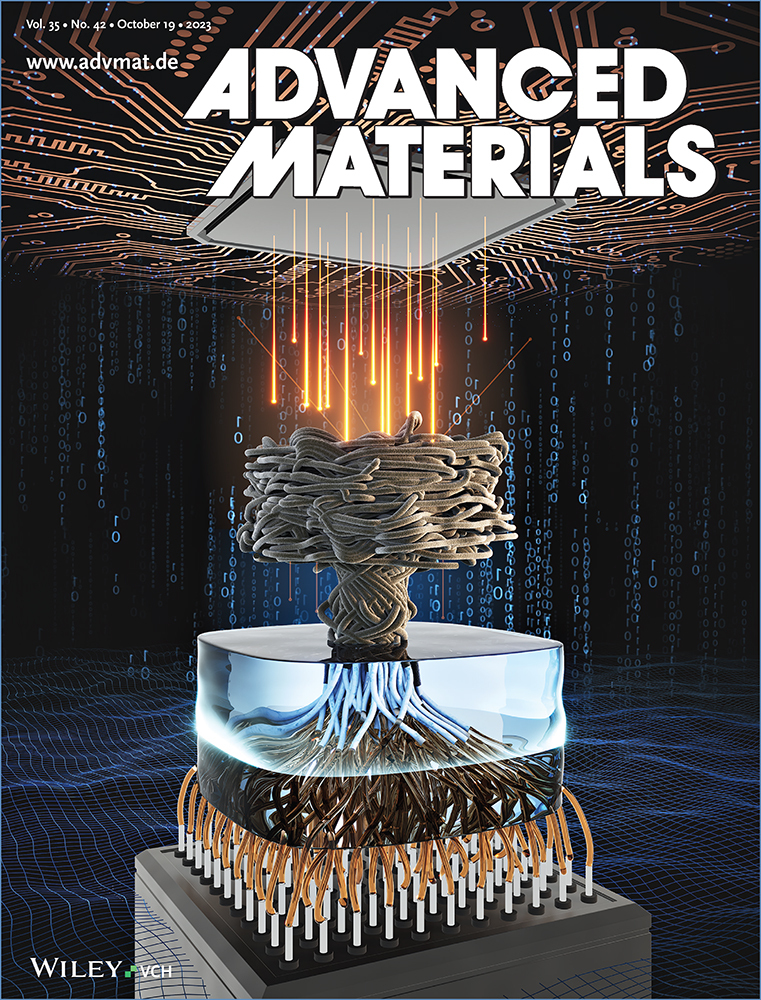
Emerging 2D Metal Oxides: From Synthesis to Device Integration
Author:Kui Zhou, Gang Shang, Hsiao-Hsuan Hsu, Su-Ting Han, Vellaisamy A. L. Roy, Ye Zhou
Year:2023
Source publication:Advanced Materials Volume35, Issue21, May 25, 2023, 2207774
Subfield Highest percentage:99% Mechanical Engineering # 3 / 631