Fast-Response, Highly Air-Stable, and Water-Resistant Organic Photodetectors Based on a Single-Crystal Pt Complex
In this work, we report the efficient fabrication of PDs based on this single-crystalline, polyfluorinated Pt complex (1o), which renders the device with a high field-effect mobility of up to 0.45 cm2 V−1 s−1 at a threshold voltage as low as 1.12 V.
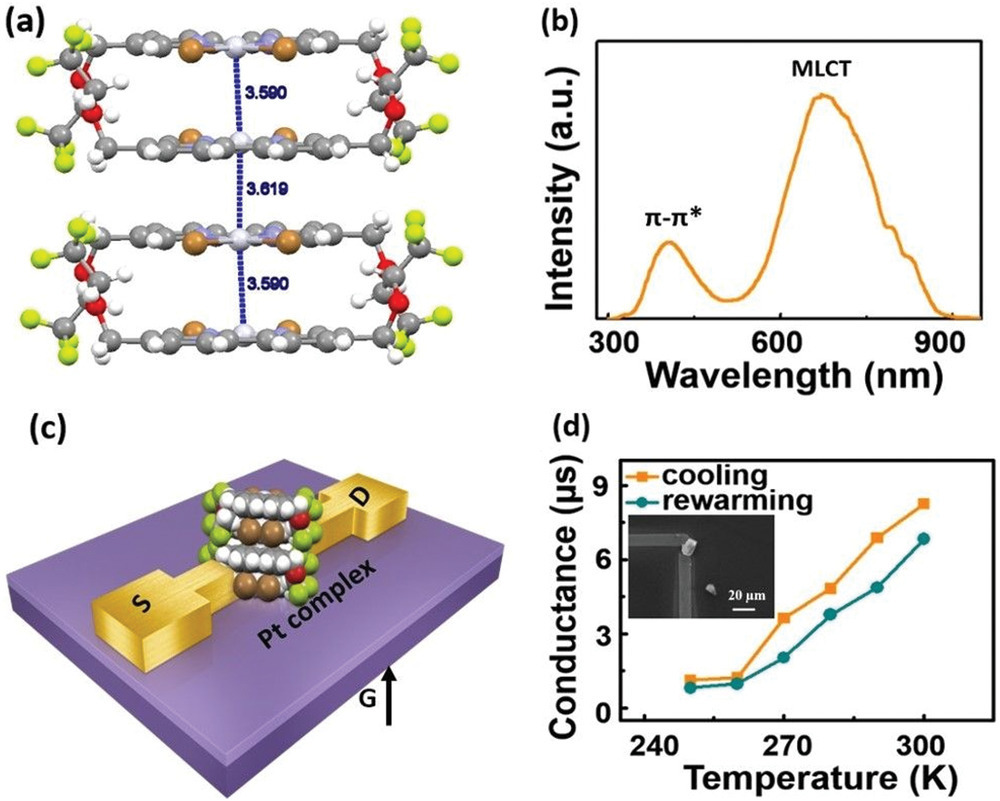
Figure 1
Preliminary characterization of the Pt complex (1o) crystals. a) Two units of stacked dimer pairs of the Pt complex (1o) crystal. The Pt–Pt distances were 3.590 Å within the dimer-pair unit and 3.619 Å between the two closest neighboring units. (Note that C, H, O, N, F, Br, and Pt are in gray, write, red, blue, yellow, brown, and silver color, respectively]. b) Photoluminescence spectrum of the Pt complex (1o) with an excitation wavelength of 325 nm at room temperature. c) Illustration of the structure of the Pt-complex (1o) device. d) Temperature-dependent conductivity of the Pt complex (1o). Inset shows the scanning electron microscopy (SEM) image of the fabricate Pt-complex (1o) device.
Technology Overview
The polyfluorinated Pt-complex (1o) device discussed herein shows a stable mobility (up to 0.45 cm2 V−1 s−1 at a threshold voltage of 1.12 V) and water-repellant properties (a 22% and 5.7% mobility degradation after 90 days without encapsulation in air and immersion in distilled water for 24 h, respectively). Furthermore, the device features excellent photoresponsivity of 1000 A W−1 at 5 V bias and an ON/OFF switching ratio of 16 at zero gate bias, which we attribute to the high gain and low noise of the organic PD's molecular structure. The temporal response of the photocurrent reveals record response and recovery times as fast as ≈80 and ≈90 µs, respectively.
Applications & Benefits
Therefore, the polyfluorinated Pt complex (1o) can serve as a valuable reference for the development of high detectivity, long-term stability, polarization sensitive, and fast photoresponse PDs, as well as for the advancement of future integrated electronic and optoelectronic devices beyond conventional materials and techniques.
Abstract:
Organic semiconductors demonstrate several advantages over conventional inorganic materials for novel electronic and optoelectronic applications, including molecularly tunable properties, flexibility, low-cost, and facile device integration. However, before organic semiconductors can be used for the next-generation devices, such as ultrafast photodetectors (PDs), it is necessary to develop new materials that feature both high mobility and ambient stability. Toward this goal, a highly stable PD based on the organic single crystal [PtBr2(5,5′-bis(CF3CH2OCH2)-2,2′-bpy)] (or “Pt complex (1o)”) is demonstrated as the active semiconductor channel—a material that features a lamellar molecular structure and high-quality, intraligand charge transfer. Benefitting from its unique crystal structure, the Pt-complex (1o) device exhibits a field-effect mobility of ≈0.45 cm2 V−1 s−1 without loss of significant performance under ambient conditions even after 40 days without encapsulation, as well as immersion in distilled water for a period of 24 h. Furthermore, the device features a maximum photoresponsivity of 1 × 10³ A W−1, a detectivity of 1.1 × 1012 cm Hz1/2 W−1, and a record fast response/recovery time of 80/90 µs, which has never been previously achieved in other organic PDs. These findings strongly support and promote the use of the single-crystal Pt complex (1o) in next-generation organic optoelectronic devices.
Fast-Response, Highly Air-Stable, and Water-Resistant Organic Photodetectors Based on a Single-Crystal Pt Complex
Author:Periyanagounder D., Wei T.-C., Li T.-Y., Lin C.-H., Gonçalves T.P., Fu H.-C., Tsai D.-S., Ke J.-J., Kuo H.-W., Huang K.-W., Lu N., Fang X.
Year:2020
Source publication:Advanced Materials Volume32, Issue2 January 16, 2020 1904634
Subfield Highest percentage:99% Mechanical Engineering #2/596
https://onlinelibrary.wiley.com/doi/full/10.1002/adma.201904634