Architecting hierarchal Zn3V2O8/P-rGO nanostructure: Electrochemical determination of anti-viral drug azithromycin in biological samples using SPCE
Transition metal vanadates as a multicomponent material combined with 2D material graphene has pointed with several advantages to which we have proposed novel Zn3V2O8/P-rGO nanocomposite using hydrothermal synthesis assisted by ultrasonication process.
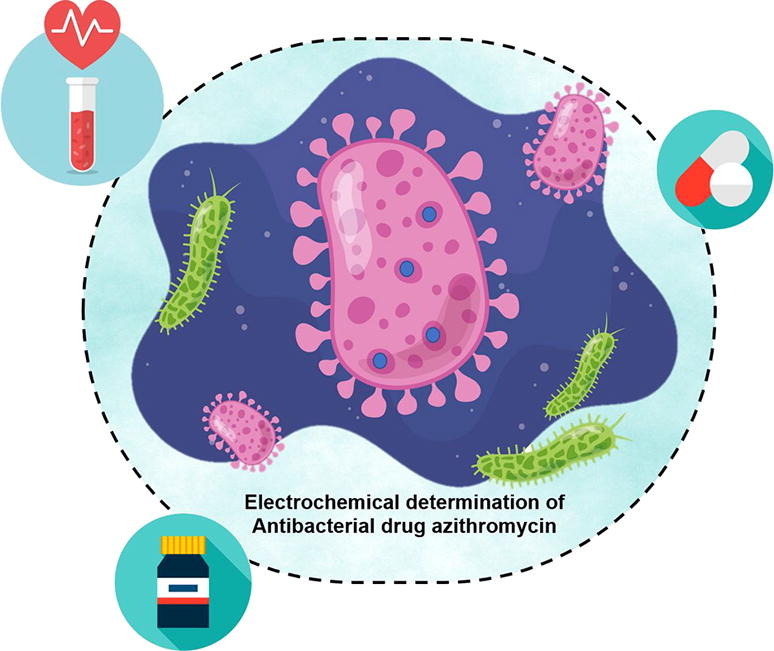
Technology Overview
Novel Zn3V2O8 nanostructure is synthesized using transition metal oxide (TMOs). Flexible Screen-printed carbon electrode (SPCE) is self-prepared using PET sheets. DPV is used to analyze AZY at a trace level limit of detection of 0.0067 μM. The Zn3V2O8/P-rGO/SPCE has displayed a high sensitivity of 17.59 µA µM−1 cm−2. Real-sample analysis is carried out by using biological and environmental samples.
Applications & Benefits
The prepared sensor has specific selectivity with high reproducibility and stability through real sample monitoring in human blood serum, urine, and wastewater samples to present environmentally friendly strategy in determination of AZY.
Abstract:
The hierarchical nanostructures have attained immense significance due to their superior electrode performance, large active sites, electronic states, stability and conductivity. Transition metal vanadates as a multicomponent material combined with 2D material graphene has pointed with several advantages to which we have proposed novel Zn3V2O8/P-rGO nanocomposite using hydrothermal synthesis assisted by ultrasonication process. Azithromycin (AZY) is one of the top prioritized antibiotics which is used by humans at high concentrations. Where the side effects and waste produced by AZY to human and environment is causing significance damage. Thereover, there is much need to develop a sensitive and selective method for the determination of AZY using flexible screen-printed carbon electrode (SPCE). Characteristic analysis like FE-SEM, TEM, XRD, FT-IR, and Raman analysis were performed to determine the crystal, physical, chemical, and surface properties. Cyclic voltammetry and differential pulse voltammetry (DPV) analysis determined prepared Zn3V2O8/P-rGO/SPCE electrode has a low limit of detection (LOD) of 0.0067 μM with a sensitivity of 17.5921 µA µM−1 cm−2 (S/N = 3) and with a linear range of 0.099–450 μM towards determination of AZY. The prepared sensor has specific selectivity with high reproducibility and stability through real sample monitoring in human blood serum, urine, and wastewater samples to present environmentally friendly strategy in determination of AZY.
Architecting hierarchal Zn3V2O8/P-rGO nanostructure: Electrochemical determination of anti-viral drug azithromycin in biological samples using SPCE
Author:Tata Sanjay Kanna Sharma, Kuo-Yuan Hwa
Year:2022
Source publication:Chemical Engineering Journal Volume 439, July 2022, 135591
Subfield Highest percentage:99% Industrial and Manufacturing Engineering #3/336
https://www.sciencedirect.com/science/article/pii/S1385894722010932