Lewis adduct approach for self-assembled block copolymer perovskite quantum dots composite toward optoelectronic application: Challenges and prospects
This review highlights major key points to understand and address for the design and fabrication of original BCP-PQDs composite with remarkable versatility, stability and high performances in presented optoelectronic applications.
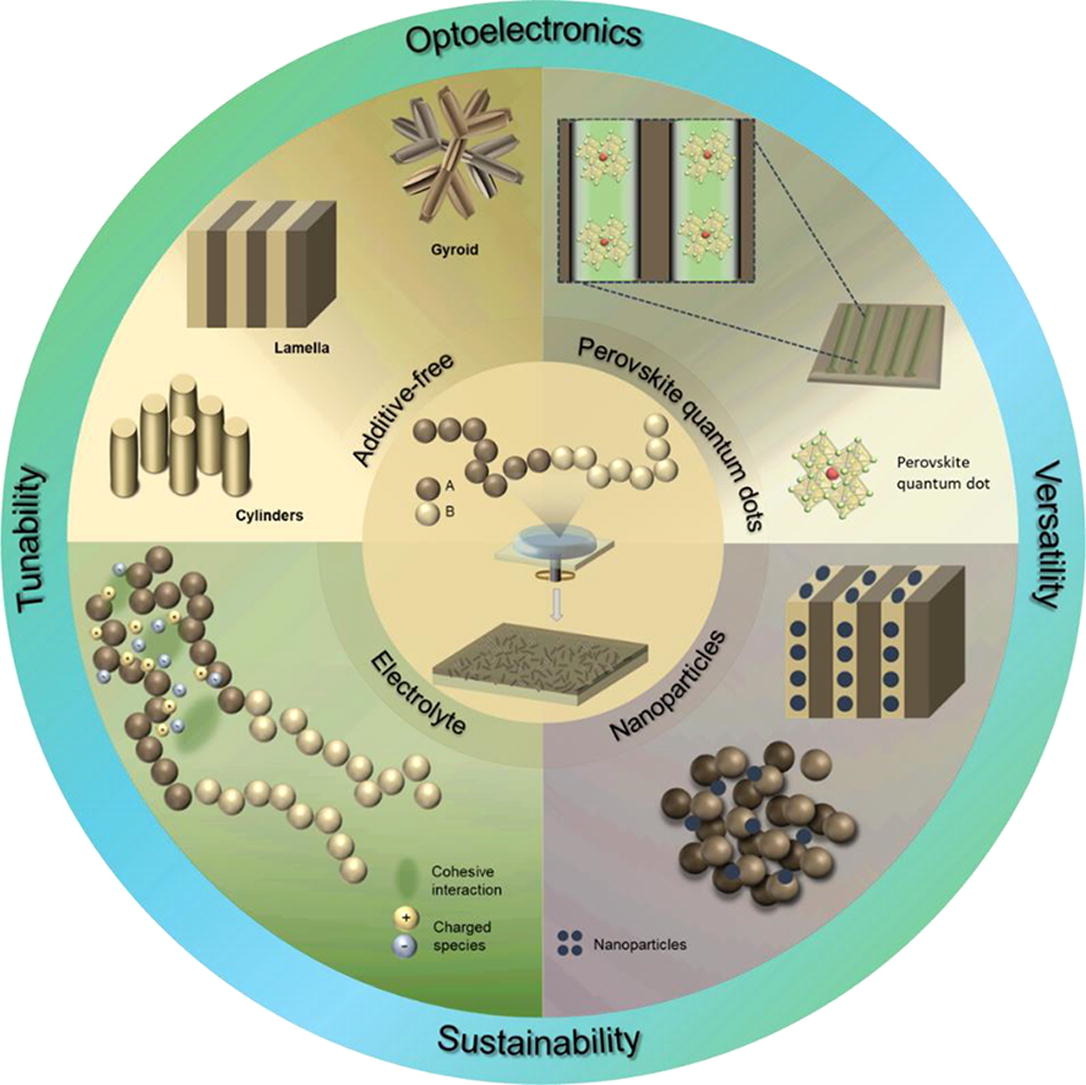
An insightful perspective toward the design and fabrication of new phase segregated block copolymers–perovskite quantum dots composite through Lewis acid-base adduct for a wide range of wearable electronics application.
Technology Overview
Understanding of the thermodynamic contribution of nanoparticle additive. Investigation of the Lewis acid-base block copolymer-bulk perovskite composite. Effect of Lewis adduct and thermodynamic for perovskite quantum dots additive. Versatile block copolymer-perovskite quantum dots self-assembled composite approach. BCP-PQDs composite-based optoelectronic conceptualization and exploration.
Applications & Benefits
BCP are fascinating and versatile materials that self-assemble into numerous geometrical features and act as efficient hosts for additives. BCP-PQDs composites will be regarded as versatile, highly resistant materials with highly efficient optoelectronics performance for various applications.
Abstract:
In-depth understanding of block copolymer (BCP) thermodynamics allows to obtain numerous self-assembled nanostructures and further extend the BCP capabilities to host additives. Therefore, different research groups have begun incorporating additives of versatile nature such as nanoparticles or electrolytes. Within BCP composite systems, additives alter the original BCP self-assembled structure in which host–guest interaction must be further investigated. Recently, perovskite revealed to be a promising optoelectronic material but its applications have been limited due to insufficient long-term stability. Polymeric Lewis base interaction with perovskite precursor has emerged as a strong approach to obtain highly stable perovskite. To address the potential application and versatility of perovskite materials, this review summarizes recent advances and highlights a new potentially sustainable approach to BCP encapsulation of perovskite quantum dots (PQDs) through Lewis acid-base interaction. The conceptual composite aims to drastically enhance perovskite stability through controlled chemical and thermodynamic interaction between the BCP and PQDs. This review highlights major key points to understand and address for the design and fabrication of original BCP-PQDs composite with remarkable versatility, stability and high performances in presented optoelectronic applications.
Lewis adduct approach for self-assembled block copolymer perovskite quantum dots composite toward optoelectronic application: Challenges and prospects
Author:Benas, J.-S., Liang, F.-C., Chen, W.-C., Hung, C.-W., Chen, J.-Y., Zhou, Y., Han, S.-T., Borsali, R., Kuo, C.-C.
Year:2022
Source publication:Chemical Engineering Journal Volume 431, Part 4, 1 March 2022, 133701
Subfield Highest percentage:99% Industrial and Manufacturing Engineering #3/336
https://www.sciencedirect.com/science/article/pii/S138589472105275X