Numerical and experimental investigations on thermal management for data center with cold aisle containment configuration
This study presents a container data center via the cold aisle containment design combining with a HX on the airside and a EWC on the waterside as an effective solution to enhance the operational performance of existing and future data centers used in tropical and subtropical areas.
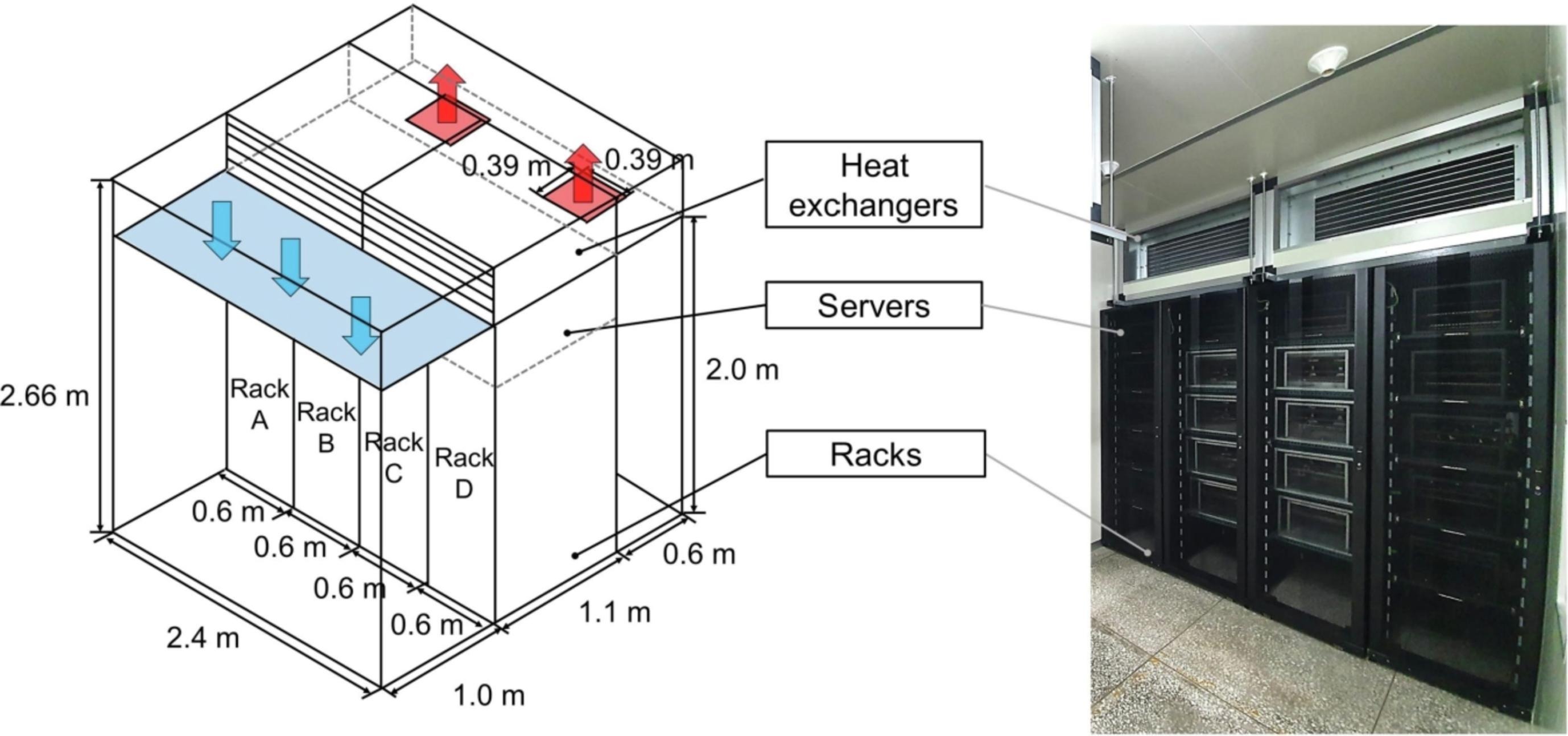
Fig. 2. Schematic diagram and relevant geometric details of simulated test data center.
Technology Overview
Cooling solution adopts heat exchanger/evaporative water chiller on air/water sides. Thermal control is enhanced using overhead downward flow with cold aisle containment. Effects of supply air temperature and velocity on data center performance are studied. A good power usage efficiency of 1.38 is achieved for planned large-scale data center.
Applications & Benefits
Overall, the calculated average PUE of 1.38 for the large-scale data center is notably less than the average PUE of 1.59 from the results of 2020 data center industry survey, indicating the potential savings of cooling energy and cost. This paper demonstrates a generalized approach as an easily adaptable, cost-effective solution for data centers to be deployed in tropical and subtropical areas.
Abstract:
This study proposes the container data center with the featured cold aisle containment (CAC) as effective thermal control strategy. In design, the overhead downward flow system is implemented with a heat exchanger arranged right above the data center on the air side and an evaporative water chiller on the water side to form the cooling approach. The cold airflows and hot exhausts of racks are separately transported by the contained cold and hot aisles to alleviate the problem of cold and hot air mixing. The measurements of air temperature and velocity of racks are used to validate the prediction accuracy of the computational fluid dynamics (CFD) model. The performance metrics in terms of the rack cooling index (RCI), return temperature index (RTI), supply heat index (SHI) are used to examine the design effectiveness of the proposed test data center. The simulations are then extended to assess the air distribution and thermal management at varied supply air temperatures and velocities for a large-scale data center to be built in the green energy technology demonstration site of the Shalun smart green energy science city. Overall, the calculated average PUE of 1.38 for the large-scale data center is notably less than the average PUE of 1.59 from the results of 2020 data center industry survey, indicating the potential savings of cooling energy and cost. This paper demonstrates a generalized approach as an easily adaptable, cost-effective solution for data centers to be deployed in tropical and subtropical areas.

Numerical and experimental investigations on thermal management for data center with cold aisle containment configuration
Author:Lee Y.-T., Wen C.-Y., Shih Y.-C., Li Z., Yang A.-S.
Year:2021
Source publication:Applied Energy Available online 22 November 2021, 118213
Subfield Highest percentage:99% Building and Construction #1/185
https://www.sciencedirect.com/science/article/pii/S030626192101480X