Facile one-pot synthesis of rod-coil bio-block copolymers and uncovering their role in forming the efficient stretchable touch-responsive light emitting diodes
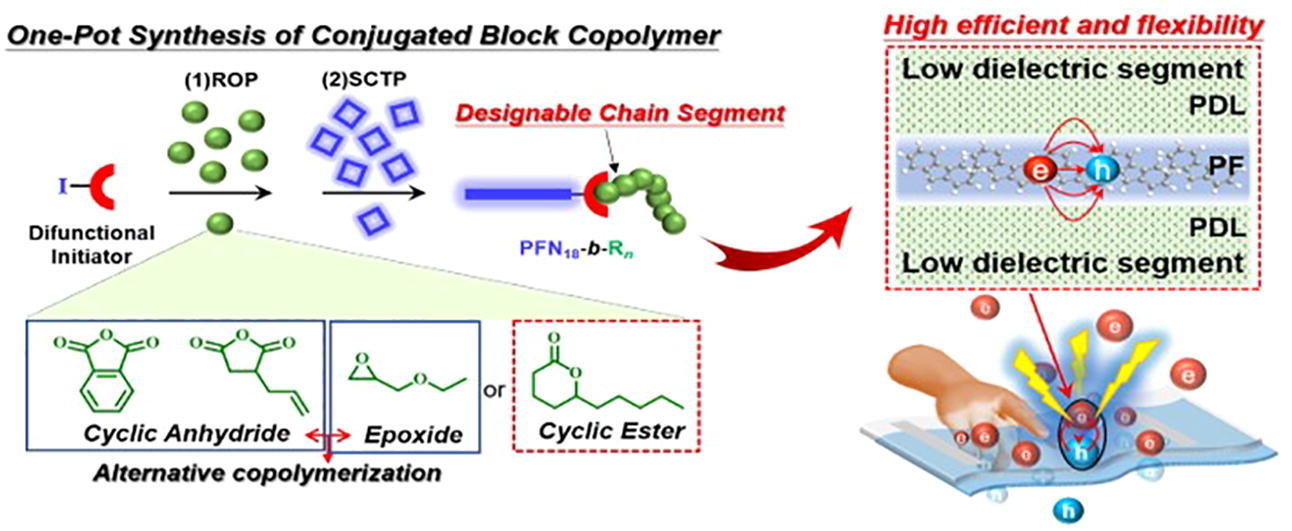
One pot synthesized bio derived and polyfluorene-based (PF-based) conjugated block copolymers exhibited high mechanical flex-stretch endurance and could effectively suppress non-radiative recombination through insulating block present in the conjugated block contributes to higher exciton binding energy. They showed potential for fabricating highly durable wearable stretchable nano and microelectronic devices.
Technology Overview
Facile synthesis of PF-based BCPs addresses the limitations in the synthetic field. High PLQY value can be induced by coil block due to high EBE. The LED with PF-BCPs exhibits 6 times EQE greater than one with PF homopolymer. The stretchable LED shows high flexibility (strain 150%) and endurance (300 cycles). The touch-responsive LEDs exhibits excellent stability and durability.
Applications & Benefits
Mechanically robust highly flexible and stretchable touch-responsive LEDs with ultra-high efficiency were fabricated with PF18-b-PDL13 capable of integrating with human finger, curved joints and smart garments. The findings of this study possibly elevated the conjugated BCPs importance with robust stretchable wearable LED fabrication and our one pot smart synthesis is anticipated to achieve impressive breakthroughs in forming diverse eco-friendly materials and wearable electronic fabrication.
Abstract:
Bio-derived optoelectronic material is captivating and sustainable research as it reduces the environmental toxicity and comforting the wearable aspects. Our research involves the synthesis of series of bio-derived polyfluorene-block-poly(δ-decanolactone) (PF-b-PDL) conjugated block copolymers through smart one-pot procedure that involves simple purification for fabricating touch-responsive light-emitting diode (LED) devices. Compared with PF homopolymer, the block copolymers exhibit higher photoluminescence quantum yields and higher exciton binding energies. PF18-b-PDL13 specifically exhibits external quantum efficiency (EQE %) (~6 times higher than PF homopolymer). Moreover, because of coily PDL block inducing a highly stable bound state in block copolymer generating the increment in PL lifetime and exciton binding energies than the homopolymer. Furthermore, the diblock copolymers device exhibits fully solution processability, higher carrier recombination efficiency, flex-stretch stability, good structural integrity and mechanical endurance highlighting the brighter potential of our bio-derived block copolymers for fabricating highly durable wearable stretchable nano and microelectronic devices.
Facile one-pot synthesis of rod-coil bio-block copolymers and uncovering their role in forming the efficient stretchable touch-responsive light emitting diodes
Author:Jiang D.-H., Ree B.J., Isono T., Xia X.-C., Hsu L.-C., Kobayashi S., Hoon Ngoi K., Chen W.-C., Jao C.-C., Veeramuthu L., Satoh T., Huang Tung S.
Year:2021
Source publication:Chemical Engineering Journal Volume 418 129421
Subfield Highest percentage:99% Industrial and Manufacturing Engineering #3/336
https://www.sciencedirect.com/science/article/pii/S1385894721010093