A simple one-step method with wide processing window for high-quality perovskite mini-module fabrication
Perovskite photovoltaic technologies have opened new horizons for low-cost solar cells.
Technology Overview
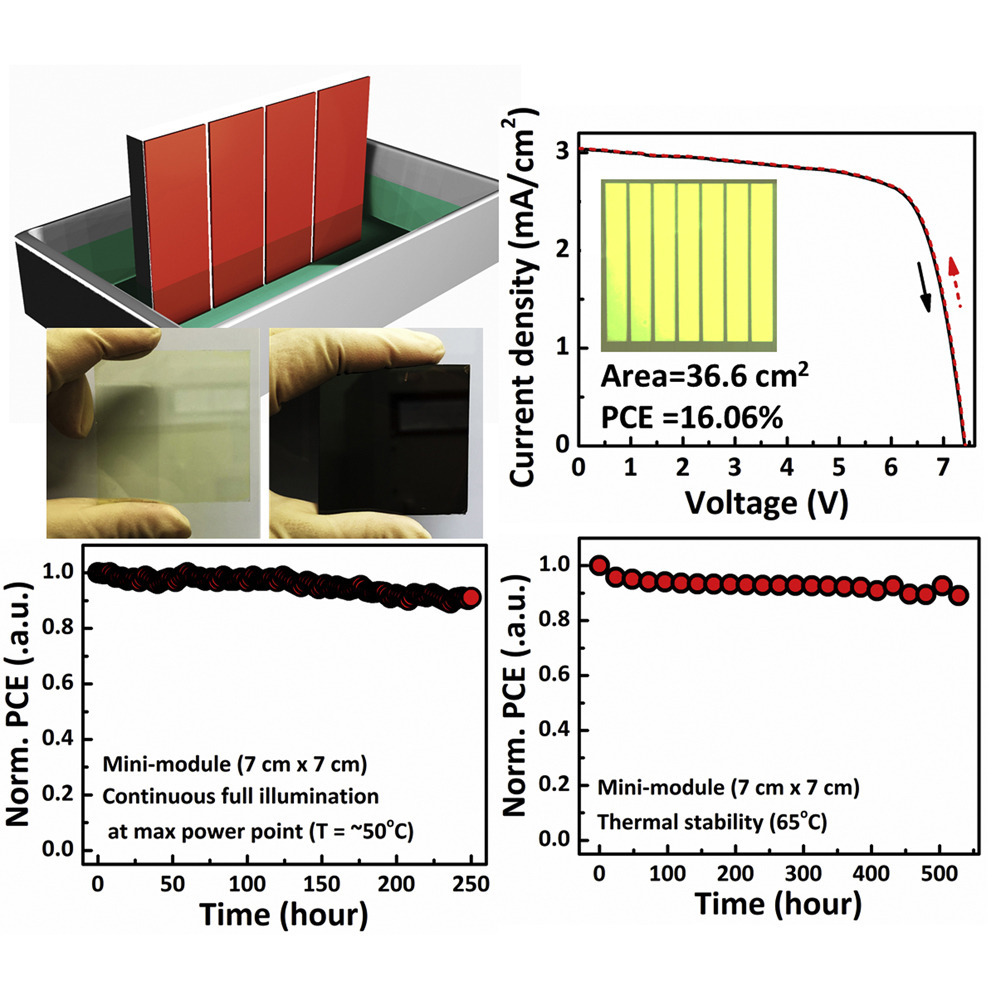
The sulfolane additive in the perovskite precursor can extend the processing window and obtain a large-scale perovskite crystal film with high uniformity. When the module is a 36.6 cm2 micro module, its efficiency is as high as 16.06%. It is found that the device has a long service life under light when heated.
Applications & Benefits
In order to use laboratory-scale batteries for modules, the challenges of creating scalable manufacturing, increasing high device yields, and extending service life need to be carefully addressed. Here, we introduce sulfolane into the perovskite precursor to solve the above-mentioned challenges. More importantly, the service life of the micro-modules is greatly extended: they retain approximately 90% of their initial performance after 250 hours of continuous illumination at 50°C. Our method provides a promising solution for upgrading perovskite photovoltaics with high-yield and long-life module production.
Abstract:
The one-step antisolvent approach is a widely employed method for fabricating perovskite devices at a low cost. However, the current antisolvent approach requires a strict set of processing conditions to obtain high-quality perovskite layers. Here, we introduce sulfolane as an additive in the perovskite precursor to convert the perovskite phase via a new reaction route, providing a large degree of flexibility to process crystalline perovskite layers with high uniformity on a large scale. As it is revealed by X-ray diffraction and Fourier-transform infrared spectroscopy findings, we find that the key concept lies in intermolecular hydrogen-bonding forces’ interaction between sulfolane and methylammonium iodide, which slows down the nucleation and subsequently the crystallization process. As a result, we demonstrate a mini module, 36.6 cm² active area, and achieve a record PCE of 16.06%. More importantly, the encapsulated mini module retained about 90% of the initial performance after operating at the maximum power point under simulated AM1.5G irradiation for 250 h at 50°C.

A simple one-step method with wide processing window for high-quality perovskite mini-module fabrication
Author:Huang H.-H., Liu Q.-H., Tsai H., Shrestha S., Su L.-Y., Chen P.-T., Chen Y.-T., Yang T.-A., Lu H., Chuang C.-H.a, Lin K.-F., Rwei S.-P., Nie W.d, Wang L.
Year:2021
Source publication:Joule Volume 5 Issue 4 Pages 958-974
Subfield Highest percentage:99% General Energy (2020) #1/6
https://www.sciencedirect.com/science/article/abs/pii/S2542435121000891